Encryption - Crypto 101
Introduction
This is my resolution of Encryption - Crypto 101 room of TryHackMe.
Task 1: What will this room cover?
This room will cover:
- Why cryptography matters for security and CTFs.
- The two main classes of cryptography and their uses.
- RSA, and some of the uses of RSA.
- 2 methods of Key Exchange.
- Notes about the future of encryption with the rise of Quantum Computing.
Answer:
No answer needed
Task 2: Key terms
I agree not to complain too much about how theory heavy this room is.
Answer:
No answer needed
Are SSH keys protected with a passphrase or a password?
Answer:
passphrase
Separate to the key, a passphrase is similar to a password and used to protect a key.
Task 3: Why is Encryption important?
What does SSH stand for?
Answer:
Secure Shell
How do webservers prove their identity?
Answer:
certificates
When you connect to your bank, there’s a certificate that uses cryptography to prove that it is actually your bank rather than a hacker.
What is the main set of standards you need to comply with if you store or process payment card details?
Answer:
PCI-DSS
Standards like PCI-DSS state that the data should be encrypted both at rest (in storage) AND while being transmitted. If you’re handling payment card details, you need to comply with these PCI regulations.
Task 4: Crucial Crypto Maths
What’s 30 % 5?
Answer:
0
What’s 30 % 5?
Answer:
4
What’s 118613842 % 9091
Answer:
3565
Task 5: Types of Encryption
Should you trust DES? Yea/Nay
Answer:
Nay
Symmetric encryption uses the same key to encrypt and decrypt the data. Examples of Symmetric encryption are DES (Broken) and AES.
What was the result of the attempt to make DES more secure so that it could be used for longer?
Answer:
Triple DES
Triple Data Encryption Standard (Triple DES or 3DES) is a symmetric block cipher-based cryptography standard that uses fixed length keys with three passes of the DES algorithm.
Source: The Triple DES Intro: Triple Data Encryption Standard
Is it ok to share your public key? Yea/Nay
Answer:
Yea
Asymmetric encryption uses a pair of keys, one to encrypt and the other in the pair to decrypt. Examples are RSA and Elliptic Curve Cryptography. Normally these keys are referred to as a public key and a private key. Data encrypted with the private key can be decrypted with the public key, and vice versa. Your private key needs to be kept private, hence the name.
Task 6: RSA - Rivest Shamir Adleman
p = 4391, q = 6659. What is n?
Answer:
29239669
The key variables that you need to know about for RSA in CTFs are p, q, m, n, e, d, and c. “p” and “q” are large prime numbers, “n” is the product of p and q.
I understand enough about RSA to move on, and I know where to look to learn more if I want to.
Answer:
No answer needed
Task 7: Establishing Keys Using Asymmetric Cryptography
I understand how keys can be established using Public Key (asymmetric) cryptography.
Answer:
No answer needed
Task 8: Digital signatures and Certificates
What can you use to verify that a file has not been modified and is the authentic file as the author intended?
Answer:
Digital Signature
Digital signatures are a way to prove the authenticity of files, to prove who created or modified them
Task 9: SSH Authentication
I recommend giving this a go yourself. Deploy a VM, like Linux Fundamentals 2 and try to add an SSH key and log in with the private key.
Answer:
No answer needed
Download the SSH Private Key attached to this room.
Answer:
No answer needed
What algorithm does the key use?
Answer:
RSA
Crack the password with John The Ripper and rockyou, what’s the passphrase for the key?
First, I open my Kali-linux vm and connected to TryHackMe via VPN (see more in Setup Kali VM for TryHackMe).
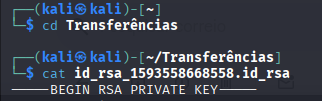
Then, download the SSH Private Key file and visualise the content using
catcommand:
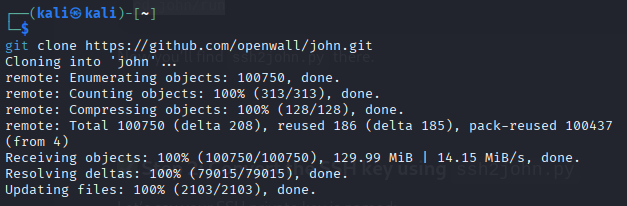
- To crack the password using John the Ripper I cloned the repo using:
- Using Rockyou to crack it:
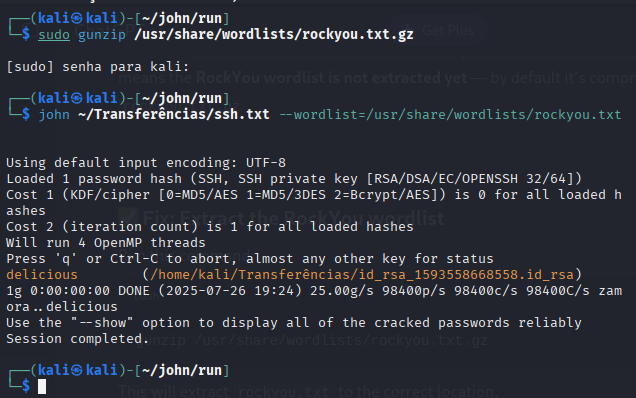
I used the rockyou.txt wordlist because it’s one of the most popular real-world password lists, leaked from a historical data breach. It contains millions of common passwords that people actually use, making it highly effective for dictionary-based attacks in tools like John the Ripper.
Answer:
delicious
Task 10: Explaining Diffie Hellman Key Exchange
I understand how Diffie Hellman Key Exchange works at a basic level
Answer:
No answer needed
Task 11: PGP, GPG and AES
Time to try some GPG. Download the archive attached and extract it somewhere sensible.
Answer:
No answer needed
Time to try some GPG. Download the archive attached and extract it somewhere sensible.
- Download the file and unziping the task files:
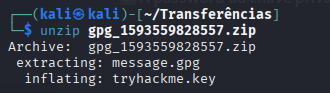
- Then, import the key:
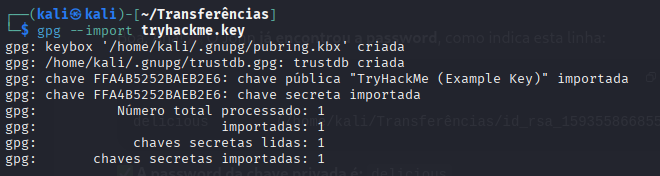
- And decrypt the file:

- Finally, viewing the file content:
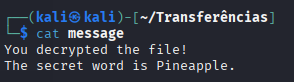
Answer:
Pineapple
This task demonstrates the use of GPG (GNU Privacy Guard), which is a free implementation of the OpenPGP standard. GPG allows to secure encrypt and decrypt files using a hybrid encryption approach — it uses asymmetric encryption (via public/private key pairs) to securely exchange the symmetric AES key, which is then used to encrypt the actual data.
In this challenge, the .gpg file was encrypted using the recipient’s public key. By importing the provided tryhackme.key (private key) into GPG, I was able to decrypt the file and retrieve the hidden message. This showcases a real-world application of encryption used in secure email, file sharing, and digital signatures, where confidentiality and authenticity are essential.
Task 12: The Future - Quantum Computers and Encryption
I understand that quantum computers affect the future of encryption. I know where to look if I want to learn more.
Answer:
No answer needed